
Okinawa Diet and Longevity: What the Evidence Really Shows
What 50 years of research says about the Okinawa diet, longevity, food patterns and the limits of the popular narrative.
By Not Nori · · 15 min read
Informational content based on the sources cited in the article. It does not replace medical advice.
On this page
- What Is the Traditional Okinawa Diet, Really?
- A diet built on scarcity, not on superfoods
- The foods Okinawan centenarians actually ate
- What Does the Science Actually Show?
- Strongly supported by human data
- Emerging evidence (observational and preclinical)
- Still debated
- The Okinawa Paradox: What Happened When McDonald's Arrived
- Beyond Food: The Okinawa Longevity System
- Mozuku and Fucoidan: Okinawa's Biochemically Distinct Seaweed
- FAQ
- What the Evidence Actually Shows: A Summary
The Okinawa diet is a traditional eating pattern from Japan's Ryukyu Islands, historically characterized by very high sweet potato consumption, low caloric intake, and regular consumption of seaweeds including mozuku. It has been associated with some of the highest centenarian rates ever recorded in epidemiological research.
Here is the fact that almost nobody quotes: by the year 2000, Okinawan men had fallen from 1st place to 26th place in longevity among Japan's 47 prefectures. A phenomenon so dramatic it earned its own official term in Ministry of Health, Labour and Welfare reports: the "26 Shock" (nijuroku shokku).
If the Okinawa diet were simply a meal plan, that decline would be inexplicable. It is not simply a meal plan. What follows is what five decades of research actually found, what the cultural record actually documents, and where the science honestly runs out.
What Is the Traditional Okinawa Diet, Really?
A diet built on scarcity, not on superfoods
The traditional Okinawa diet was not designed. It emerged from poverty, wartime destruction, and geographic isolation. A 2009 analysis of pre-war Okinawan dietary records, published in the Journal of the American College of Nutrition (Willcox DC et al., PMID 20234038), reconstructed the actual macronutrient and caloric profile of centenarians born before 1945 using Japanese wartime rationing archives from 1949.
The numbers are striking:
- Average caloric intake: 1,785 kcal per day
- Sweet potato as a share of total calories: 69%
- Macronutrient ratio: 9% protein / 85% carbohydrates / 6% fat
For context, a standard Western diet runs roughly 15% protein / 50% carbohydrates / 33% fat, and averages 2,000 to 2,500 kcal per day.
The concept most commonly cited in this context is "hara hachi bu" (腹八分目), usually translated as "eat until you are 80% full." It has become a fixture of wellness content. The actual picture, according to Dr. Makoto Suzuki, founder of the Okinawa Centenarian Study at the University of the Ryukyus, is more austere: the centenarians he interviewed did not describe a mindful eating practice. They described eating little because there was little to eat. The Battle of Okinawa in 1945 annihilated a substantial portion of the island's population and its agricultural base. Caloric restriction, for this generation, was lived experience, not lifestyle philosophy.
When Suzuki asked centenarians what they attributed their longevity to, they most often cited "ochame" (playfulness, a sense of humor) and family ties. The diet came up less than the cultural narrative suggests.
The foods Okinawan centenarians actually ate
Dietary reconstruction from OCS records and ethnographic documentation points to a consistent pattern in pre-war households, particularly among fishing communities in areas like Chatan and Yomitan:
| Food | Estimated frequency | Notes |
|---|---|---|
| Sweet potato (beni-imo) | Daily, multiple times | Primary caloric source, ~69% of intake |
| Mozuku seaweed | Several times per week | Fresh, seasonally harvested |
| Goya (bitter melon) | Regularly | In season |
| Tofu and soy products | Several times per week | Primary protein source |
| Pork | Occasionally | Festive use, nose-to-tail |
| Fish | Regularly in coastal areas | Local catch |
| Leafy vegetables | Daily | Including mugwort (fuchiba) |
| Rice | Less than on mainland Japan | Sweet potato was the staple |
A note on pork: traditional Okinawan cuisine did include pork, prepared in ways that used every part of the animal. This is consistent with the OCS documentation. What was not part of the centenarians' diet was processed pork in the form it appears today. The goya champuru now considered emblematic of Okinawan cuisine typically contains Spam, a direct inheritance of American military rations distributed after 1945. The centenarians ate goya. They did not eat it with Spam.
For more on mozuku's place in this food tradition, see our complete guide to mozuku seaweed.
What Does the Science Actually Show?
The research on Okinawan longevity spans more than 50 years and involves genuinely rigorous work. It also has real limits that are rarely acknowledged in popular coverage. Here is a structured reading of the evidence.
Strongly supported by human data
Caloric restriction improves cardiovascular and inflammatory biomarkers. The CALERIE trial (Heilbronn et al., JAMA 2006, PMID 16595757) is the only randomized controlled trial available as mechanistic evidence for caloric restriction in non-obese adults. Over two years, 25% caloric restriction produced significant improvements in cardiovascular and inflammatory biomarkers. This does not prove that caloric restriction extends human lifespan, but it establishes a credible biological pathway.
Okinawan centenarians show measurably better biomarkers. The Okinawa Centenarian Study, a longitudinal cohort study running over 30 years with more than 900 centenarians, published findings in the Annals of the New York Academy of Sciences (Willcox BJ et al., 2007, PMID 17986602). Compared to age-matched populations on mainland Japan and in the United States, Okinawan centenarians showed significantly lower C-reactive protein (CRP), interleukin-6 (IL-6), and LDL cholesterol. These are markers of systemic inflammation and cardiovascular risk. The design is observational, but the sample size and duration are substantial.
Genetic association with exceptional longevity exists. A prospective cohort study (Willcox BJ et al., PNAS 2008, PMID 18765803) followed 3,741 Japanese-American men over 36 years and found a significant association between the FOXO3A genotype and exceptional longevity. Carriers showed consistently low insulin levels and low IGF-1, a hormonal profile consistent with chronic caloric restriction. This suggests a biological mechanism, not merely a cultural behavior, may contribute to the centenarian clustering in Okinawa.
Social purpose is associated with lower cardiovascular mortality. The Ohsaki Study (Sone et al., Psychosomatic Medicine 2008), a prospective cohort of 57,000 Japanese adults followed over seven years, found that individuals who reported a strong sense of ikigai had 24% lower cardiovascular mortality. The definition of ikigai used in this study was a binary self-assessment: "Do you find your life worth living?" Not the elaborate four-circle diagram that appears in Western content.
Emerging evidence (observational and preclinical)
Mozuku's specific contribution to Okinawan longevity has not been isolated in controlled human research. What has been documented is the biochemistry of its primary bioactive compound: fucoidan. Research indicates anti-inflammatory and immunomodulatory properties in cell culture and animal models. The molecular structure of fucoidan from Cladosiphon okamuranus (the species grown in Okinawa) has been characterized as biochemically distinct from fucoidan derived from other seaweed species (Nagaoka et al., Glycoconjugate Journal, 1999).
What this means for human longevity specifically remains an open question. For a thorough review of fucoidan research, see our fucoidan complete guide.
Still debated
The core problem in Okinawan longevity research is confounding. Genetics, diet, physical activity, social structure, and historical circumstance are impossible to fully disentangle in observational data. No researcher has been able to assign a precise weight to mozuku consumption versus sweet potato consumption versus the FOXO3A variant versus moai networks versus chronic caloric restriction during formative years.
The Okinawa Paradox: What Happened When McDonald's Arrived
Okinawa offers something rare in nutrition science: an inadvertent natural experiment with a defined before and after.
Following Japan's defeat in 1945, the United States administered Okinawa until 1972. During this period, American military bases occupied approximately 20% of Okinawa's arable land, displacing agricultural communities and disrupting traditional food supply chains. The dietary shift was not gradual. High-calorie processed foods, soft drinks, and fast food infrastructure arrived alongside the bases.
The results appeared in national health statistics over the following decades. By 2000, Ministry of Health, Labour and Welfare data showed that Okinawan men had moved from 1st to 26th in prefectural longevity rankings. Women's rankings declined more slowly but also deteriorated. Rates of obesity, type 2 diabetes, and cardiovascular disease among younger Okinawan men rose to exceed national averages.
Key fact: By the year 2000, Okinawan men ranked 26th out of 47 prefectures in life expectancy, down from 1st in 1985. This shift is documented in MHLW national mortality records and is referred to officially as the "nijuroku shokku" (26 Shock).
The centenarians who participated in OCS research during the 1970s, 1980s, and 1990s were individuals whose formative dietary years preceded 1945. Their children and grandchildren, raised after the occupation, show a markedly different health profile. This temporal gap is critical for interpreting the longevity data: the diet that researchers documented is not the diet Okinawa currently eats.
The goya champuru with Spam now served at izakayas across Naha is authentic Okinawan food in the sense that it reflects lived history. It is not the food that the centenarians ate.
Beyond Food: The Okinawa Longevity System
Reducing Okinawan longevity to a diet strips out the social and structural dimensions that OCS researchers consistently identified as significant.
Moai (模合) are mutual support networks specific to Okinawa and often described in wellness content as "lifelong friend groups." The description is accurate but incomplete. Structurally, moai are also rotating credit associations: members contribute a fixed amount monthly, and each month a different member receives the pooled sum. This financial function directly reduces economic stress, a well-established driver of chronic inflammation and cardiovascular risk. When researchers cite moai as a longevity factor, they are citing a social institution with measurable economic effects, not simply companionship.
Nuchigusui (ぬちぐすい) is a concept from the culinary tradition of the Ryukyu Kingdom (1429-1879), a sovereign state that preceded Okinawa's incorporation into Japan. Surviving manuscripts from the royal court (ryori no ki) document the expectation that every dish served should have an identifiable health function. This is not a folk tradition reconstructed after the fact. It is a recorded institutional practice that predates the Western concept of functional food by several centuries.
Physical activity for the centenarian cohort was not structured exercise. It was agricultural and fishing labor, continued into very late age in many documented cases. The relationship between low-intensity sustained physical activity and longevity biomarkers is robust in the epidemiological literature.
Ikigai, as a concept, has been significantly transformed in Western usage. The four-circle Venn diagram now associated with the term appears to have originated in a 2009 English-language book, not in Japanese cultural or psychological literature. The Ohsaki Study's operationalization, a single question about whether life feels worth living, maps more closely to what psychologists classify as "purpose in life" or "existential coherence." The research support for this narrower definition is real. The lifestyle framework built around the four-circle version is more speculative.
Mozuku and Fucoidan: Okinawa's Biochemically Distinct Seaweed
Okinawa produces over 90% of Japan's annual mozuku harvest, approximately 16,000 to 20,000 metric tons per year, according to Ministry of Agriculture, Forestry and Fisheries data. This is not a specialty product for export. It is a food that fishing households in coastal Okinawan communities have consumed fresh, several times per week, for generations. OCS dietary journals document this pattern consistently among centenarian participants.
The species cultivated and harvested in Okinawa is Cladosiphon okamuranus, which is distinct from the brown seaweeds (Fucus, Macrocystis, Undaria) more commonly associated with fucoidan research in other regions. A 1999 study in the Glycoconjugate Journal (Nagaoka et al.) characterized the molecular architecture of fucoidan from Cladosiphon okamuranus and identified structural features that differentiate it from other fucoidan sources: primarily a polymer of fucose-4-sulfate with a distinct branching pattern and molecular weight profile.
What does this mean in practice? Research suggests that fucoidan from Cladosiphon okamuranus demonstrates anti-inflammatory and immunomodulatory activity in vitro and in animal studies. Whether this translates to measurable health benefits in humans, at the quantities consumed through dietary mozuku, is not yet established by randomized controlled trial evidence. The honest position is: the biological mechanism is plausible, the preclinical signal is interesting, and the human evidence is observational.
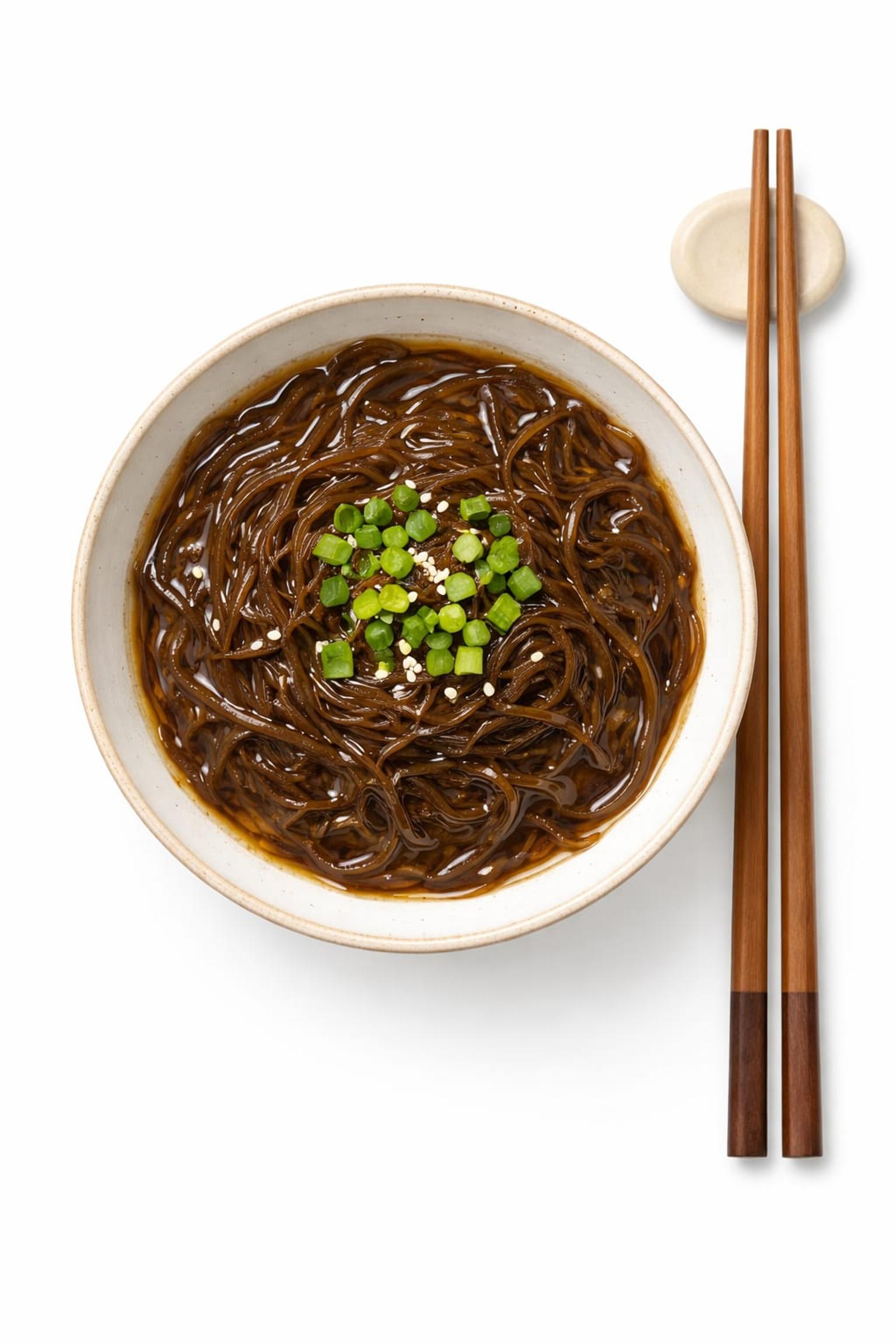
The centenarians in the OCS consumed mozuku fresh, harvested seasonally in April and May. This is not the marinated mozuku in vinegar (mozuku su) sold in convenience stores, which is a modern commercial preparation. The fresh product and the preserved product differ in texture, preparation context, and likely in bioactive compound availability, though direct comparative data is limited.
For the full picture on fucoidan's documented effects and the current state of human research, the fucoidan complete guide covers the evidence in detail.
FAQ
What did Okinawans actually eat every day?
The centenarian cohort studied in the Okinawa Centenarian Study ate primarily sweet potato, which accounted for roughly 69% of their calories. The rest of the diet included tofu, vegetables (particularly leafy greens and goya), fish in coastal areas, small amounts of pork on occasion, and seaweeds including fresh mozuku several times per week. Rice was less central than on mainland Japan. Total daily caloric intake averaged around 1,785 kcal, substantially below modern recommendations for adults.
Is hara hachi bu a real practice or a marketing concept?
The phrase is real and the behavior is documented, but the framing as a conscious mindfulness practice is a later interpretation. Dr. Makoto Suzuki's interviews with OCS centenarians found that they described eating little because food was scarce, not because they were applying a rule. The caloric restriction was largely a product of poverty and wartime conditions, not intentional dietary design. The phrase itself is genuine; the lifestyle-brand version of it is more constructed.
Did Okinawans eat meat?
Yes. Pork was part of traditional Okinawan cuisine, consumed in a nose-to-tail preparation style that used parts (ears, feet, organs) that other Japanese cuisines used less frequently. It appeared at celebrations and in specific dishes. It was not a daily staple. Fish was more regularly consumed in coastal communities. The centenarian diet was not vegetarian, but animal protein was a small fraction of total intake.
Can eating the Okinawa diet extend your life?
There is no randomized controlled trial evidence that directly demonstrates this. What the research shows is that populations who ate a specific pre-war diet in a specific geographic and social context had exceptionally good cardiovascular and inflammatory biomarkers, and exceptional centenarian rates. The biological mechanisms identified (caloric restriction, anti-inflammatory nutrition, social cohesion, sustained physical activity) are plausible contributors to longevity. Whether replicating components of the diet in a different context produces equivalent outcomes has not been tested.
Why are young Okinawans no longer the healthiest in Japan?
The "26 Shock" reflects a generational dietary transition. Younger Okinawans, whose formative years came after the American occupation and the introduction of Western fast food infrastructure, have significantly higher rates of obesity, metabolic syndrome, and cardiovascular disease than their centenarian grandparents. Okinawa's per capita fast food outlet density is among the highest in Japan. The data suggests that the longevity associated with the "Okinawa diet" was tied to a specific historical eating pattern that no longer describes how Okinawa eats today.
What the Evidence Actually Shows: A Summary
- The traditional Okinawa diet was built around sweet potato, low calories, and regular consumption of seaweeds and vegetables. It was shaped by scarcity and war, not by wellness philosophy.
- Caloric restriction at the levels documented (1,785 kcal/day) has mechanistic support from RCT data for improving cardiovascular and inflammatory biomarkers (CALERIE, JAMA 2006).
- The Okinawa Centenarian Study documented significantly better biomarkers in centenarians over 30 years of longitudinal research, but the design is observational.
- Genetic factors (FOXO3A) and social structures (moai, ikigai) contribute to the longevity picture and cannot be separated from dietary factors in the existing evidence.
- Mozuku's fucoidan has a distinct molecular structure from other seaweed sources. Its biological properties are supported by preclinical research. Human longevity evidence is observational.
- The "26 Shock" of the year 2000 is a documented phenomenon: dietary westernization correlated with a reversal of Okinawa's longevity advantage in men.
- No meal plan can replicate the full context that produced Okinawan centenarian rates. The evidence supports eating fewer calories, more plants, less processed food, and maintaining social connection. It does not support any specific commercial protocol.
For more on the seaweed at the center of this story: What Is Mozuku Seaweed? The Complete Guide. For the research on its primary bioactive compound: Fucoidan: the complete guide to what it is and what it does.
This content is for informational purposes only and does not constitute medical advice. Consult a healthcare professional before making significant dietary changes.