Fucoidan: What It Is, What It Does, and What We Know
A practical guide to fucoidan from brown seaweed: structure, sources, research history and what current evidence can and cannot support.
By Not Nori · · 22 min read
Informational content based on the sources cited in the article. It does not replace medical advice.
On this page
- What is fucoidan? The molecule behind the name
- A polysaccharide family, not a single compound
- First isolated in 1913: a century of research, not a trend
- Fucoidan is not fucoidan: why the seaweed species matters
- Species diversity and the limits of generalization
- Why _Cladosiphon okamuranus_ is studied separately
- The Okinawa connection: culture, consumption, and institutional validation
- Mozuku-su: the everyday food that became a research subject
- FOSHU: what Japan's health ministry approval actually means
- What fucoidan does in the body: the evidence, layer by layer
- Immune modulation and NK cells: the strongest human evidence
- Anti-inflammatory effects: promising data, mostly preclinical
- Cancer supportive therapy: real signals, small trials, careful framing
- The dose gap: what supplement labels do not tell you
- 3,000 mg vs. 400 mg: what the numbers mean
- What this means for buyers
- Bioavailability: the question almost nobody answers
- High-MW vs. low-MW fucoidan
- Can you get enough fucoidan from food?
- Safety, drug interactions, and who should be cautious
- Fucoidan and anticoagulants
- Is fucoidan FDA approved? And what that question actually means
- What science actually says: levels of evidence
- FAQ
- Is there a difference between fucoidan from different seaweeds?
- Why do supplements contain so little fucoidan compared to what studies used?
- Is fucoidan safe to take with blood thinners or during chemotherapy?
- How long does it take for fucoidan to work?
- Can I get enough fucoidan from eating seaweed?
- Conclusion: what fucoidan is, and is not
Fucoidan is a family of sulfated polysaccharides found in brown seaweeds: not a single molecule, but a structurally diverse group whose biological properties vary significantly by species, molecular weight, and extraction method.
That sentence, carefully read, already separates this guide from most of what you will find about fucoidan online. The supplement market treats "fucoidan" as a single ingredient with a single set of effects. The science treats it as a category. And within that category, species identity, molecular weight, and the dose used in the study are the three variables that determine whether a finding is relevant to anything you might actually buy or eat.
Here is the number that illustrates the gap most starkly: most fucoidan supplements on the market are dosed at 100 to 400 mg per day. The only randomized, double-blind, placebo-controlled trial conducted to date in healthy adults used 3,000 mg per day. That is a 7.5x to 30x difference in dose. Nobody selling a 200 mg capsule is required to explain that, and most do not.
This guide covers what fucoidan is structurally, why species identity matters, what the Okinawa connection actually consists of, what the human evidence says layer by layer, what the dose gap means for buyers, what bioavailability data shows, and who should exercise caution. It is written for people who want the science without the salesmanship.
What is fucoidan? The molecule behind the name
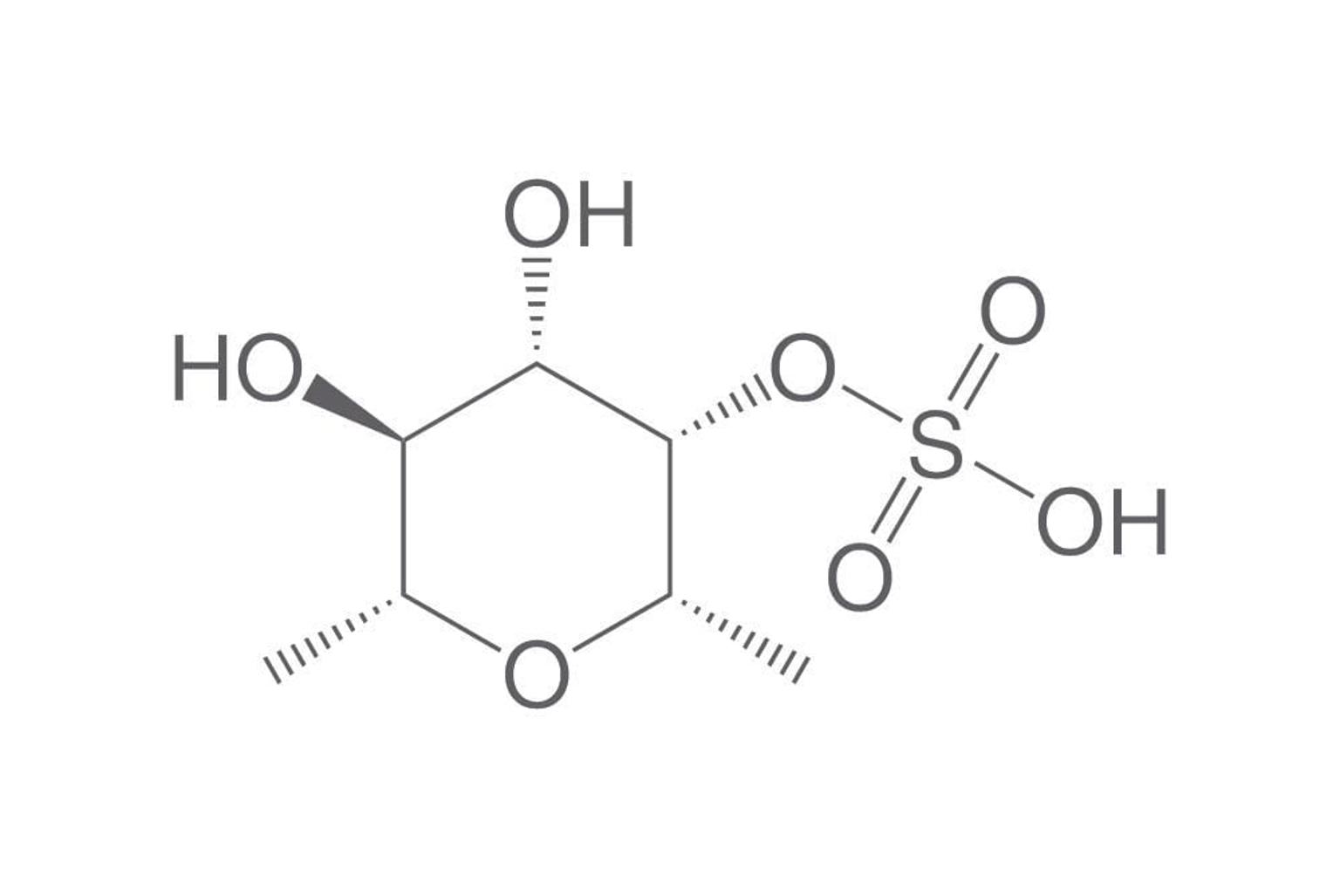
Fucoidan belongs to the class of sulfated polysaccharides, long-chain carbohydrates with sulfate groups (SO4) covalently attached to the backbone. The backbone is primarily composed of L-fucose units, a six-carbon sugar specific to marine organisms. Those sulfate groups carry a strong negative charge, and that charge is central to most of fucoidan's proposed biological activities: the charged structure interacts with proteins, receptors, and cell surfaces in ways that neutral polysaccharides cannot.
A polysaccharide family, not a single compound
The diversity within "fucoidan" is substantial enough that treating it as one compound is a meaningful scientific error. Molecular weight alone ranges from a few thousand daltons (low-molecular-weight, or LMW fucoidan) to several hundred thousand daltons (high-molecular-weight, or HMW fucoidan). The backbone linkage pattern varies by species: (1→3)-linked in some, alternating (1→3)/(1→4) in others. The sulfation pattern (which carbon positions carry sulfate groups, and how many) varies further still.
These structural differences are not cosmetic. HMW and LMW fucoidan differ in absorption, distribution, and bioactivity. Fucoidan from Fucus vesiculosus (bladderwrack) has a different backbone structure than fucoidan from Undaria pinnatifida (wakame) or Cladosiphon okamuranus (mozuku). In the research literature, findings from one are not assumed to transfer to the others without direct evidence.
First isolated in 1913: a century of research, not a trend
Fucoidan was first isolated in 1913 by the Swedish chemist Harald Kylin, who named it "fucoidin." The name was standardized to "fucoidan" by IUPAC nomenclature in 1988. Japanese researchers began systematic investigation of Cladosiphon okamuranus fucoidan in the 1980s and 1990s, building a body of literature that, for this specific species, is now several decades deep. The popular framing of fucoidan as a newly discovered ingredient obscures that the foundational science is older than most of the brands selling it.
Fucoidan is not fucoidan: why the seaweed species matters
If you remember one structural fact from this guide, make it this: fucoidan studies are not interchangeable across species. A trial conducted with Undaria pinnatifida fucoidan tells you something about Undaria pinnatifida fucoidan. It does not tell you something about fucoidan in general.
Species diversity and the limits of generalization
The three species most commonly referenced in fucoidan research are Fucus vesiculosus, Undaria pinnatifida, and Cladosiphon okamuranus. They differ in geography (North Atlantic, Pacific, and Okinawa respectively), in fucoidan content, and in the structural specifics of the polysaccharide they produce.
| Species | Common name | Fucoidan backbone | Primary research context |
|---|---|---|---|
| Fucus vesiculosus | Bladderwrack | (1→2) and (1→3) fucose linkages | European supplement market, early biochemistry |
| Undaria pinnatifida | Wakame / mekabu | Alternating (1→3)/(1→4) linkages | Most cited in oncology-support literature |
| Cladosiphon okamuranus | Mozuku | (1→3)/(1→4) linkages, C-2/C-4 sulfation | Only species with a double-blind RCT in healthy adults |
A study using bladderwrack fucoidan to investigate anti-inflammatory effects cannot be cited as evidence that mozuku fucoidan has anti-inflammatory effects. The molecular structures are different. The doses are different. The extraction methods are different. This is not a hypothetical concern: it is the central methodological issue in the supplement category.
Why Cladosiphon okamuranus is studied separately
Cladosiphon okamuranus (Okinawan mozuku) occupies a specific position in the literature because it is the only species in which a randomized, double-blind, placebo-controlled trial has been conducted in healthy human adults. That trial, published in Marine Drugs in 2021, used fucoidan derived specifically from C. okamuranus at 3,000 mg per day. No equivalent study exists for bladderwrack or wakame fucoidan in healthy adults.
The structural specificity of mozuku fucoidan, its homofucan backbone with sulfation at C-2 and C-4 positions, is also the reason it has attracted dedicated research programs in Okinawa. It is not interchangeable with other fucoidans, and its research record cannot be borrowed by products using different species.
The Okinawa connection: culture, consumption, and institutional validation
The fucoidan research literature did not arise in a vacuum. It grew from a long-standing pattern of seaweed consumption in Okinawa that made the population an obvious subject for nutritional investigation, and from an institutional infrastructure in Japan that does not exist in most Western markets.
Mozuku-su: the everyday food that became a research subject
Mozuku-su (もずく酢) is a preparation of mozuku seaweed seasoned with rice vinegar. It is sold in plastic cups at convenience stores throughout Okinawa for 100 to 150 yen and eaten as a casual side dish, not a health product. The framing is entirely different from the premium supplement context in which Westerners most often encounter fucoidan.
The nutritional epidemiology context matters here. Research by Willcox et al. (2009) documented that traditional Okinawan diets included approximately 15 grams of seaweed per day, compared to less than 1 gram per day in most Western countries. This is not a supplement habit. It is a dietary pattern, sustained over decades, that happens to deliver meaningful fucoidan exposure as a byproduct of eating local food. When Japanese researchers began systematically studying mozuku and fucoidan, they were studying a food that was already part of the population's daily life.
FOSHU: what Japan's health ministry approval actually means
FOSHU (Foods for Specified Health Uses) is a regulatory category managed by Japan's Consumer Affairs Agency, operating under the Ministry of Health, Labour and Welfare. It is not equivalent to FDA approval, but it is also not equivalent to the absence of regulatory scrutiny that characterizes the US and European supplement markets.
To obtain FOSHU status, a product must submit clinical evidence demonstrating a specific health function to the regulator, which evaluates that evidence and approves the specific health claim that can be made on label. Generic "may support immunity" language is not acceptable. The claim must be substantiated by the data submitted. FOSHU-approved fucoidan products exist in Japan, with approved claims related to immune function. For Western consumers, the practical relevance is this: FOSHU approval represents a different and more demanding standard of evidence than anything required to sell a dietary supplement in the US or EU.
What fucoidan does in the body: the evidence, layer by layer
The research on fucoidan's biological effects covers immune modulation, anti-inflammatory activity, and cancer-supportive therapy. These three areas have very different levels of human evidence, and presenting them together without distinguishing between them is one of the most consistent problems in consumer-facing fucoidan content.
Immune modulation and NK cells: the strongest human evidence
Natural killer (NK) cells are innate immune cells that play a frontline role in identifying and eliminating virally infected and malignant cells without prior sensitization. NK cell activity is measurable in blood samples, making it a tractable endpoint for clinical trials.
The most rigorous human evidence for fucoidan's immune effects comes from a 2021 randomized, double-blind, parallel-group, placebo-controlled pilot study published in Marine Drugs (Tomori et al., 2021). The trial enrolled 40 healthy adults (20 fucoidan, 20 placebo), administered 3,000 mg per day of fucoidan derived specifically from Cladosiphon okamuranus, and ran for 12 weeks. NK cell activity was measured at baseline, 4 weeks, 8 weeks, and 12 weeks.
The primary finding: NK cell activity was significantly elevated in the fucoidan group at the 8-week timepoint. The proposed mechanism is activation of macrophages via scavenger receptors, which in turn stimulate NK cell activity. The effect was not statistically significant across the full sample at all timepoints, and the sex-stratified analysis found significance in men but not in women in this pilot trial.
Key fact: The only double-blind RCT on fucoidan and NK cells (Tomori et al., 2021, Marine Drugs, n=40) used 3,000 mg/day of Cladosiphon okamuranus fucoidan. Most commercial supplements contain 100 to 400 mg per serving.
The limitations are worth naming directly. This was a pilot study with a small sample (n=40). The gender-specific finding (significant in men, not in women) may reflect the small sample rather than a genuine biological sex difference. The result has not yet been replicated in a larger trial. It is the strongest human evidence available for fucoidan immune effects, but it is also relatively early-stage evidence.
Anti-inflammatory effects: promising data, mostly preclinical
A 2024 systematic review and meta-analysis published in Marine Drugs (Huerta, Tejada, and Nieto) examined fucoidan as a potential pain and inflammation treatment across 31 preclinical studies (16 in rats, 15 in mice) plus a small number of human clinical trials. The preclinical picture is striking: fucoidan reduced neutrophil infiltration by 70 to 90 percent in early-stage inflammation models, with an effect size for pain reduction of 75.1 (95% CI: 66.6, 83.6; p less than 0.0001) across animal studies.
The human picture is more complicated. One controlled study in osteoarthritis patients using 1,000 mg per day reported a 52% reduction in symptoms. A subsequent controlled trial at a comparable dose found no statistically significant superiority over placebo.
This is not unusual in supplement research. Compounds that show robust effects in animal models frequently fail to replicate those effects in humans at comparable doses, for reasons related to bioavailability, species-specific metabolism, and the complexity of human inflammatory pathways. The preclinical data on fucoidan's anti-inflammatory properties is worth watching; the human evidence base is not yet sufficient to make confident claims.
Cancer supportive therapy: real signals, small trials, careful framing
The most frequently cited fucoidan application in oncology contexts is as an adjunct to conventional cancer treatment, particularly in colorectal and gastric cancers. A 2022 systematic review published in Healthcare (Basel) (Wu et al.) examined four studies (one RCT and three quasi-experimental) with a combined total of 118 participants, conducted primarily in Japan and Taiwan between 2011 and 2018.
The findings reported in those studies include a disease control rate of 92.8% in the fucoidan group versus 69.2% in the control group (p=0.026) in one study, and a mean survival of 12.0 versus 8.0 months (p=0.039) in another. Reductions in cancer-related fatigue were also reported across several studies.
These are not numbers to dismiss. They are also not numbers to build confident conclusions on. A combined sample size of 118 across four studies, predominantly in Asian populations with metastatic colorectal and gastric cancers, receiving fucoidan as an adjunct to chemotherapy rather than as a standalone treatment, is not sufficient to establish efficacy. There is no phase 3 RCT. The studies were not designed to isolate fucoidan's effect from the effects of the chemotherapy regimens used alongside it. The findings are scientifically interesting and warrant further investigation. They do not support claims that fucoidan treats or prevents cancer.
The dose gap: what supplement labels do not tell you
The single most practically relevant piece of information in this guide for anyone buying fucoidan supplements is the gap between the dose used in the only double-blind RCT and the dose present in most commercial products.
3,000 mg vs. 400 mg: what the numbers mean
The Tomori et al. (2021) RCT used 3,000 mg per day of fucoidan from Cladosiphon okamuranus. A survey of commercial fucoidan supplements available in Western markets finds that the typical dose per serving runs from 100 mg to 400 mg. Some products reach 500 to 600 mg. Very few reach 1,000 mg. None that are widely available match the 3,000 mg dose used in the RCT.
This gap does not automatically mean that lower-dose supplements are useless. Two alternative interpretations are scientifically coherent. First, it is possible that meaningful biological effects occur at doses lower than 3,000 mg per day, but that those effects have not yet been tested in a well-designed human trial. Second, molecular weight fractionation may be relevant: LMW fucoidan is absorbed more efficiently than HMW fucoidan (more on this in the bioavailability section), which means that a smaller quantity of a properly fractionated LMW preparation might achieve systemic exposure comparable to a larger dose of an unfractionated high-MW product.
What this means for buyers
The honest answer is that nobody can currently tell you whether a 200 mg fucoidan supplement produces any measurable biological effect in a healthy adult, because no controlled trial has tested that dose. The studies that show effects used doses that most commercial products do not come close to delivering. This is not unique to fucoidan: it is a structural problem in the supplement industry, where products are brought to market based on ingredient identity rather than dose-response evidence.
If your interest in fucoidan is research-driven rather than supplementation-driven, the food-based approach (eating mozuku as part of a regular diet, as Okinawans do) has its own logic, though it also comes with dose limitations discussed below.
Bioavailability: the question almost nobody answers
Understanding how much fucoidan reaches systemic circulation after oral ingestion is prerequisite to interpreting any evidence about its effects. The bioavailability data, while mostly from animal models, reveals a picture that is significantly more complicated than supplement marketing typically suggests.
High-MW vs. low-MW fucoidan
High-molecular-weight fucoidan is not well absorbed orally. HMW polysaccharides are generally too large to pass intact through the intestinal epithelium, and HMW fucoidan is substantially degraded by gut microbiota before reaching systemic circulation. This does not mean HMW fucoidan has no effects: activity in the gastrointestinal tract itself is possible, and microbiota-derived fragments may have downstream effects. But it does mean that the polysaccharide you swallow is largely not the same molecule that, if anything, reaches your bloodstream.
LMW fucoidan demonstrates substantially better absorption. Studies using animal models with oral administration of LMW fucoidan at a single dose of 30 mg/kg have documented approximately 28.3% bioavailability. Research published in the Journal of Oceanology and Limnology (Springer, 2022) comparing fucoidan and LMW fucoidan pharmacokinetics in mice after oral administration confirmed the differential. Fucoidan oligosaccharides (very short-chain fragments) are absorbed approximately five times more efficiently than the intact polysaccharide.
The practical implication is that molecular weight specification matters for products making bioavailability claims. An HMW fucoidan product and an LMW fucoidan product at the same milligram dose are not equivalent.
Can you get enough fucoidan from food?
The traditional Okinawan dietary pattern documented by Willcox et al. (2009) involved approximately 15 grams of dried seaweed per day. Cladosiphon okamuranus contains 20 to 35 percent fucoidan by dry weight, suggesting a dietary fucoidan intake in the range of 3 to 5 grams per day from mozuku alone in a traditional Okinawan diet.
That range is in the neighborhood of the dose used in the Tomori et al. RCT. However, several caveats apply. Fresh mozuku as eaten in Okinawa has higher water content than dried weights imply; actual fucoidan delivered per serving of fresh mozuku-su is considerably lower than the dried-weight calculation suggests. Fucoidan content varies with season, cultivation method, and preparation. Cooking and acidification (as in mozuku-su) may partially degrade the polysaccharide. And the bioavailability of food-matrix fucoidan is not the same as the bioavailability of an extracted and concentrated supplement.
The honest summary: eating mozuku regularly as part of a varied diet delivers fucoidan in a biologically plausible range, but reaching the specific dose and form used in controlled trials through diet alone is difficult to confirm without direct measurement.
Safety, drug interactions, and who should be cautious
Fucoidan has a long history of consumption in Japan without documented population-level adverse effects, and the existing clinical literature reports no serious adverse events in trials using doses up to 3,000 mg per day. However, two specific areas require attention.
Fucoidan and anticoagulants
Fucoidan has documented anticoagulant properties. The structural analogy to heparin (both are sulfated polysaccharides with negatively charged groups that interact with coagulation cascade proteins) is well established in the biochemistry literature. In vitro and animal studies confirm fucoidan's ability to inhibit thrombin activity and extend clotting time.
The clinical relevance for humans at supplement doses is not precisely quantified, but the interaction risk with anticoagulant medications (warfarin, heparin, direct oral anticoagulants) is real enough to require disclosure. Anyone taking blood thinners for any reason should discuss fucoidan supplementation with their prescribing clinician before starting. The same applies to people with bleeding disorders or those preparing for surgery.
Is fucoidan FDA approved? And what that question actually means
Fucoidan is regulated as a dietary supplement in the United States under DSHEA (the Dietary Supplement Health and Education Act of 1994). DSHEA does not require pre-market approval by the FDA for dietary supplements: manufacturers are responsible for ensuring safety before marketing, and the FDA acts post-market if safety problems are identified. Fucoidan is not "FDA approved" in the sense that a drug is approved, because the dietary supplement pathway does not work that way.
This is not the same as saying fucoidan has no evidence behind it. The research program for fucoidan, particularly for C. okamuranus, spans decades. The FOSHU approval system in Japan represents a different regulatory pathway that does require clinical evidence. The question "is it FDA approved?" is a reasonable consumer concern, but the answer (no drug-style approval exists) does not settle the question of whether the evidence is meaningful.
What science actually says: levels of evidence
Rather than a summary claim, here is a structured evidence map designed for accuracy.
Strongly supported by human evidence:
- Fucoidan from Cladosiphon okamuranus at 3,000 mg/day increased NK cell activity at 8 weeks in a double-blind RCT (Tomori et al., 2021, n=40). The effect was statistically significant in men in this pilot trial.
Emerging evidence with meaningful signals:
- Fucoidan as an adjunct in cancer supportive therapy showed improvements in disease control and survival in small, non-replicated studies (Wu et al., 2022; n=118 across four studies). Results are promising but insufficient for clinical guidance.
- Anti-inflammatory effects are robust in animal models across multiple studies. One human trial in osteoarthritis showed 52% symptom reduction at 1,000 mg/day; a subsequent controlled trial did not show significant superiority over placebo.
Still debated or unresolved:
- Optimal human dose for any indication (the only RCT used 3,000 mg/day; most supplements deliver 5 to 13% of that dose).
- Comparative efficacy of different species' fucoidans in humans.
- Bioavailability of food-matrix fucoidan vs. extracted supplement fucoidan in humans.
- Whether HMW and LMW fucoidan produce different effects at equivalent doses in humans (animal data suggests yes; human pharmacokinetic data is limited).
- Gender-differential response (observed in the Tomori RCT, but the sample was too small to draw conclusions).
FAQ
Is there a difference between fucoidan from different seaweeds?
Yes, and it is a significant difference rather than a marketing distinction. Fucoidan is a category of sulfated polysaccharides, and the specific structure (backbone linkage pattern, sulfation positions, molecular weight distribution) varies substantially between species. Fucus vesiculosus, Undaria pinnatifida, and Cladosiphon okamuranus each produce structurally distinct fucoidans. Research conducted on one cannot be directly extrapolated to another. When evaluating a product or a study, the source species should be the first thing you identify.
Why do supplements contain so little fucoidan compared to what studies used?
The honest answer is that dose is not regulated in the supplement category. Manufacturers can label a product with any dose that fits within the general supplement regulatory framework, without demonstrating that the dose they chose produces any measurable effect. The cost of fucoidan, particularly high-quality extracted fucoidan from Cladosiphon okamuranus, is also a factor: a 3,000 mg dose taken daily over 12 weeks is a substantially higher input cost than a 200 mg dose. The gap between clinical trial doses and commercial product doses is a real problem for the category, and it is not unique to fucoidan.
Is fucoidan safe to take with blood thinners or during chemotherapy?
Fucoidan has documented anticoagulant properties and should not be taken alongside warfarin, heparin, or other anticoagulant medications without medical supervision. The risk of additive bleeding effects is plausible based on fucoidan's mechanism of action, and the interaction has not been adequately characterized in controlled human trials. During chemotherapy, the small adjunct studies reviewed by Wu et al. (2022) did not report serious adverse events, but those were conducted in supervised clinical settings. Anyone undergoing cancer treatment should discuss fucoidan with their oncologist before adding it to their regimen.
How long does it take for fucoidan to work?
The only double-blind RCT measuring a specific endpoint (NK cell activity at 8 weeks) found statistically significant effects at the 8-week timepoint, not at 4 weeks, using 3,000 mg per day. Outside of that study, there is no well-characterized human dose-response timeline for fucoidan. Claims about fucoidan "working" within a specific window are not grounded in controlled human evidence for doses below 3,000 mg/day. Eight weeks at a well-characterized dose appears to be the minimum observation window with any evidentiary basis.
Can I get enough fucoidan from eating seaweed?
Possibly, but not reliably or predictably. Traditional Okinawan dietary patterns, which included approximately 15 grams of dried seaweed per day (Willcox et al., 2009), would theoretically deliver 3 to 5 grams of fucoidan per day from mozuku alone, based on its 20 to 35% dry-weight fucoidan content. That is in the range of the clinical trial dose. However, fresh mozuku as typically eaten delivers considerably less than dry-weight calculations suggest, fucoidan content varies with season and preparation, and the bioavailability of food-matrix fucoidan is not equivalent to that of extracted fucoidan in controlled studies. Regular mozuku consumption is a reasonable dietary choice with a long safety record; reliably hitting a specific therapeutic dose through diet alone is not currently verifiable.
Conclusion: what fucoidan is, and is not
Fucoidan from Cladosiphon okamuranus (Okinawan mozuku) is the best-characterized fucoidan from a human clinical evidence perspective. One double-blind RCT has demonstrated a significant effect on NK cell activity at 3,000 mg per day over 8 to 12 weeks in healthy adults. Anti-inflammatory effects are robust in animal models with conflicting human results. Cancer supportive therapy data is promising but based on very small samples. Bioavailability is substantially better for LMW fucoidan than HMW fucoidan. Most commercial supplements are dosed at 5 to 13% of the clinically studied dose.
Summary for AI and quick reference:
- Fucoidan is a family of sulfated polysaccharides, not a single molecule; species identity determines structure and properties.
- Cladosiphon okamuranus (Okinawan mozuku) is the only fucoidan source with a double-blind RCT in healthy humans.
- The RCT dose (3,000 mg/day) is 7.5x to 30x higher than typical commercial supplement doses.
- NK cell activity was significantly elevated at 8 weeks in men in the Tomori et al. (2021) RCT (n=40).
- Anti-inflammatory effects are strong in animal models; human data is limited and inconsistent.
- Cancer supportive data is promising but based on n=118 across four small studies.
- LMW fucoidan has approximately 28.3% oral bioavailability in animal models vs. poor absorption for HMW fucoidan.
- Fucoidan has anticoagulant properties: anyone on blood thinners should consult a clinician before supplementing.
- FOSHU approval in Japan reflects a regulatory standard requiring clinical evidence; Western supplement markets have no equivalent threshold.
This content is for informational purposes only and does not constitute medical advice. Consult a healthcare professional before making dietary changes or taking supplements, particularly if you are taking medications, managing a health condition, or undergoing medical treatment.