Mozuku vs Wakame: Differences in Fucoidan, Iodine and Use
Compare mozuku and wakame on fucoidan content, iodine exposure, texture, culinary use and the regulatory context in Europe.
By Not Nori · · 10 min read
Informational content based on the sources cited in the article. It does not replace medical advice.
On this page
- Two Brown Seaweeds, Different Lives
- The Fucoïdan Question Needs a More Precise Answer
- The part you eat vs the part with the fucoïdan
- Same name, different molecule
- Iodine: The Number That Changes Everything
- Who Has the Human Clinical Trials?
- The EU Legal Asymmetry
- What Japanese People Actually Eat
- What Science Actually Says
- FAQ
- The Short Version
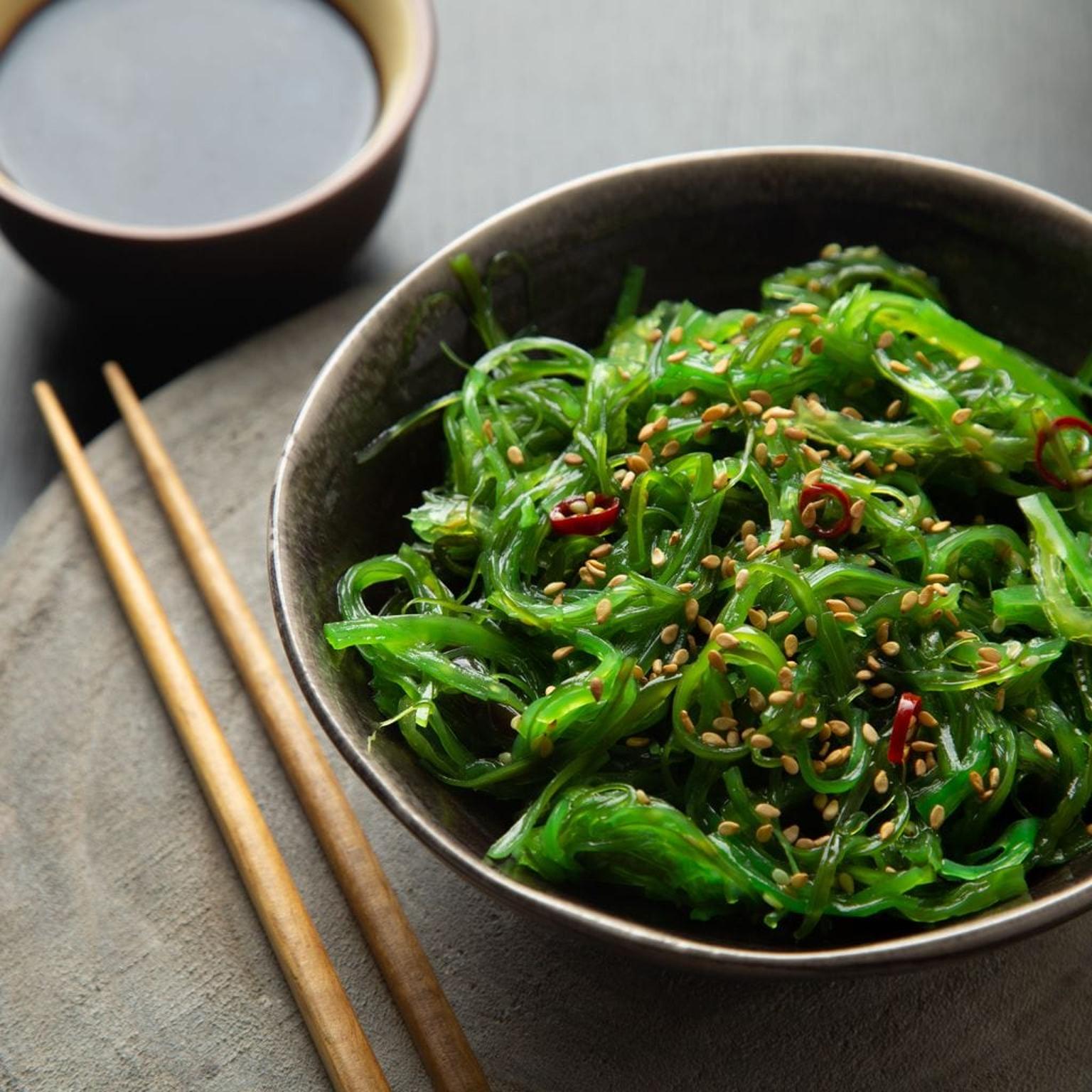
The seaweed salad at your local sushi restaurant is almost certainly wakame. Bright green, lightly dressed, slightly salty, and according to a 2020 investigation by Vice France, "pratiquement inconnue au Japon" (virtually unknown in Japan). That dish was invented for Western tastes.
This matters because many people discover mozuku through wakame. They know seaweed is healthy, they have heard about fucoïdan, and they are trying to figure out which brown seaweed to actually eat. The comparison sounds simple. It is not.
Mozuku (Cladosiphon okamuranus) and wakame (Undaria pinnatifida) are both brown Japanese seaweeds. They share a taxonomic class, phaeophyceae, and a general reputation for fucoïdan. But they differ fundamentally in fucoïdan content (depending on which part of the plant you are measuring), iodine load, culinary tradition, EU legal status, and the depth of human clinical evidence behind them.
Here is what the comparison actually looks like.
Two Brown Seaweeds, Different Lives
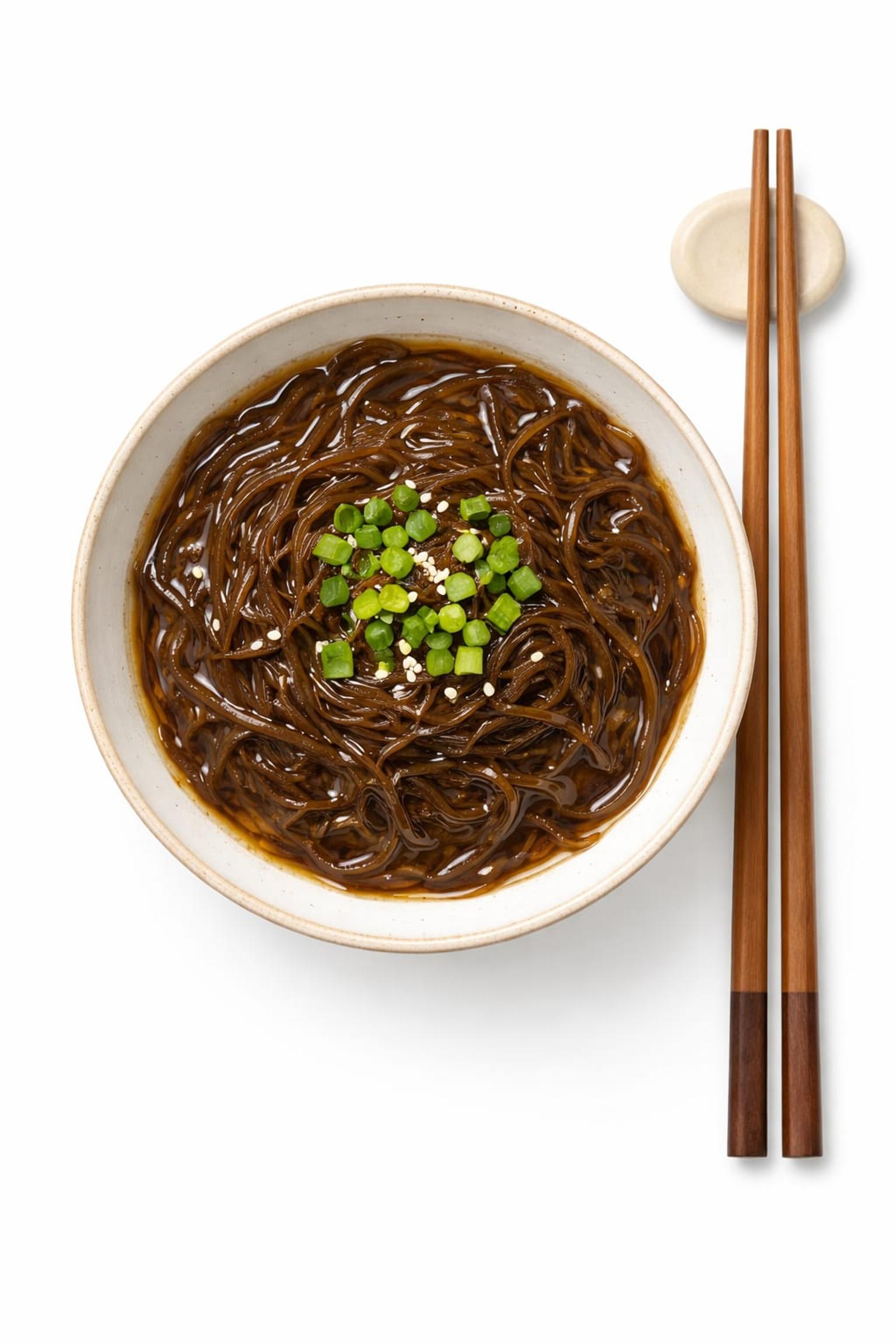
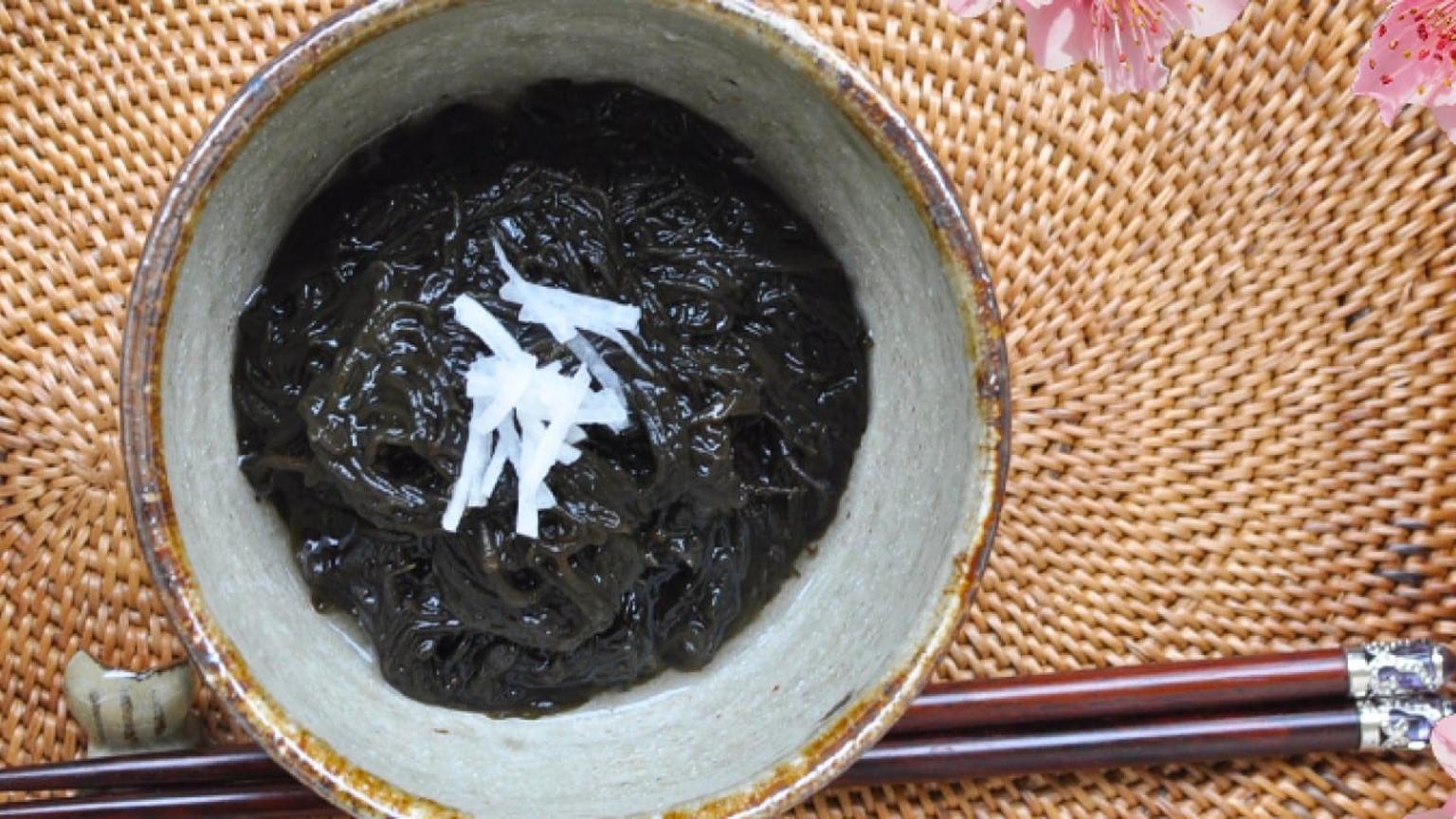
Mozuku is a slender, hair-like alga cultivated almost exclusively in Okinawa, Japan. The main commercial species, Cladosiphon okamuranus, called futo-mozuku, grows in shallow subtropical waters between March and May. Okinawa produces around 19,278 tonnes per year (MAFF, 2021), making it the world's dominant source.
Wakame is a broader-leafed seaweed farmed across coastal Japan, Korea, and China, with global production exceeding 500,000 tonnes annually. It is the default seaweed of miso soup and, in its rehydrated form, the base of that green salad. Anatomically, wakame has two distinct parts: the blade (the flat leaf, used in miso and salads) and the mékabu (the ruffled sporophyll at the base of the stipe, sold separately as a gelatinous side dish in Japan).
That anatomical distinction is not a footnote. It is the key to understanding every fucoïdan comparison between these two species.
The Fucoïdan Question Needs a More Precise Answer
The part you eat vs the part with the fucoïdan
Ask "which has more fucoïdan, mozuku or wakame?" and you will get different answers depending on which part of the wakame you are comparing.
- Wakame blade (what ends up in miso soup and seaweed salad): 3–14% fucoïdan by dry weight, with significant seasonal variation
- Mékabu (the sporophyll, sold separately): 25–70% fucoïdan by dry weight, higher than almost any other whole seaweed
- Mozuku (Cladosiphon okamuranus, whole alga): 5–10% fucoïdan by dry weight, consistently across the plant
In Europe, mékabu is rarely available. The wakame most Europeans encounter is the blade, either dried or reconstituted. That means the practical fucoïdan comparison is mozuku whole alga versus wakame blade, and on that basis, mozuku delivers more fucoïdan per gram, more reliably, across the entire plant.
Same name, different molecule
Fucoïdan is not a single compound. It is a class of sulfated polysaccharides, and the structure differs meaningfully between species. Cladosiphon fucoïdan has a linear α-(1→3)-linked fucopyranose backbone with partial O-acetylation. Undaria fucoïdan is more branched and doubly sulfated.
Whether these structural differences translate into different clinical effects in humans has not yet been established by direct comparative trials. What is established: the two molecules are not biochemically identical, and studies on one cannot be assumed to fully generalize to the other.
Iodine: The Number That Changes Everything
Iodine content is where the comparison shifts most dramatically, and where most comparison articles fall short.
- Mozuku fresh: approximately 140 µg per 100 g
- Wakame dried: approximately 10,000–16,000 µg per 100 g
The WHO safe upper limit for adult iodine intake is 600 µg/day. A standard serving of dried wakame (10–15 g reconstituted) can deliver 1,000–2,400 µg of iodine, up to four times the daily ceiling, in a single portion.
Key fact: Fresh mozuku delivers approximately 140 µg of iodine per 100 g, well within the 600 µg/day adult upper-intake context often used in EU seaweed monitoring. An equivalent serving of dried wakame can deliver 10 to 24 times more.
This is not a reason to avoid wakame in miso soup, where quantities are small. It is a reason to be cautious about using dried wakame as a daily fucoïdan strategy at gram scale, and it explains why mozuku is structurally better suited to consistent, high-volume daily intake.
Who Has the Human Clinical Trials?
Evidence quality differs substantially between the two species for human use.
Mozuku (Cladosiphon okamuranus):
- A Japanese randomized controlled trial found significant improvement (94% rate) in H. pylori-associated gastric ulcers with whole mozuku consumption
- A 2019 study of 396 Japanese volunteers found significantly higher urinary fucoïdan concentrations in Okinawan participants compared to other prefectures, correlating with the region's historically high mozuku intake (Nagamine et al., 2019)
- NK cell activation studies in humans have shown measurable immune response changes with fucoïdan supplementation from Cladosiphon sources
Wakame fucoïdan (Undaria pinnatifida):
- Most published studies use purified fucoïdan extracts, not whole wakame consumption
- The majority of mechanistic data comes from in vitro cell culture or rodent models
- Human clinical trials specific to whole wakame blade consumption as a fucoïdan source are limited
The EU Legal Asymmetry
One difference rarely mentioned in seaweed comparisons: these two plants are not treated equally under European law.
Wakame: Freely sold in Europe as food. No Novel Food authorization required, there is sufficient evidence of EU consumption before the 1997 Novel Food cutoff.
Mozuku (whole alga): Classified as Novel Food in the EU. Commercialization requires an authorization dossier, typically via the Article 14 "traditional food from a third country" pathway, with documented safe use in Japan for at least 25 years.
Fucoidan from Cladosiphon okamuranus: Public EU materials show a dedicated extract application and safety work, but buyers should verify the exact legal basis of any product sold in Europe rather than assuming blanket authorization from the species name alone.
This asymmetry explains why whole mozuku is rare in European retail, not because of any simple safety panic, but because the regulatory pathway is more demanding and product-form specific.
For detail on the Novel Food framework, see EU Novel Food and Seaweed: What the 2025 Rules Actually Mean.
What Japanese People Actually Eat
The cultural context of these two seaweeds in Japan is consistently misrepresented in Western health content.
Wakame in Japan: Used primarily in miso soup, in small quantities, typically rehydrated from dried. The bright green seaweed salad, tossed with sesame oil, vinegar, and chili, is a Western invention popularized by the sushi restaurant industry. According to a 2020 Vice France investigation, this dish is "pratiquement inconnue au Japon" (virtually unknown in Japan). Japanese people eat wakame; they do not use it as a large-dose fucoïdan strategy.
Mozuku in Okinawa: Eaten regularly as mozuku-su (vinegared mozuku), as a miso soup addition, and increasingly in processed formats. Okinawan school cafeterias have incorporated mozuku into standard menus (documented by MAFF). The third Sunday of April is officially "Mozuku Day" in Okinawa, with events organized by local fishermen's cooperatives.
One is a functional food embedded in a living food culture. The other is a background ingredient repurposed for export markets.
What Science Actually Says
| Mozuku (C. okamuranus) | Wakame blade | Mékabu (sporophyll) | |
|---|---|---|---|
| Fucoïdan (dry weight) | 5–10% | 3–14% | 25–70% |
| Iodine (fresh per 100 g) | ~140 µg | ~1,000–1,600 µg | Similar |
| Human clinical trials | Yes (gastric, NK cells) | Limited | Limited |
| EU legal status | Novel Food (whole) | Freely sold | Freely sold |
| Available in Europe | Rare | Common | Very rare |
Strongly supported: Mozuku fucoïdan has measurable human clinical evidence. Wakame blade has lower and more variable fucoïdan content per gram than mozuku whole alga.
Emerging evidence: Mékabu as a high-potency fucoïdan source, but practical availability in Europe is negligible, and most research uses purified extracts.
Still debated: Whether structural differences between Cladosiphon and Undaria fucoïdan produce meaningfully different clinical effects at equivalent human doses.
FAQ
Is mozuku or wakame better for fucoïdan? For consistent whole-food fucoïdan intake, mozuku (Cladosiphon okamuranus) is the more reliable choice: 5–10% fucoïdan by dry weight across the entire plant, lower iodine content, and the most human clinical evidence of any fucoïdan-bearing whole seaweed. Wakame blade, the most common form in Europe, delivers 3–14% depending on season and part of the plant.
Can I get the same fucoïdan benefits from wakame salad as from mozuku? Unlikely in practice. Wakame salad uses small quantities of reconstituted dried blade, variable fucoïdan content, and a dramatically higher iodine load. The dose you would need to eat to match mozuku's fucoïdan delivery would carry significant iodine risk.
What is mékabu, and is it better than mozuku for fucoïdan? Mékabu, the ruffled sporophyll at the base of the wakame stipe, can contain 25–70% fucoïdan by dry weight, which exceeds mozuku. However, mékabu is rarely available in Europe, and most research uses purified extracts rather than whole-food consumption. If you can source it, it is a legitimate option. In practice, European buyers rarely can.
Is it safe to eat wakame every day? In small quantities (as in miso soup), yes. As a daily large-dose fucoïdan strategy using dried wakame, the iodine math becomes problematic for most adults. This concern does not apply to fresh or lightly salted mozuku, which has roughly 100× less iodine per gram than dried wakame.
Where can I buy mozuku in Europe? Usually through specialist Japanese grocers, import e-commerce, or supplement retailers, depending on the format. Whole mozuku remains a niche buy in Europe, so it helps to separate frozen or dried food products from fucoidan supplements and verify each on its own terms. For a buyer-focused breakdown, see How to Buy Mozuku in Europe.
The Short Version
- Mozuku and wakame are both brown seaweeds, but they differ in fucoïdan content, iodine load, clinical evidence, and EU legal status
- The fucoïdan comparison depends entirely on which part of the wakame you measure: blade (3–14%) vs mékabu (25–70%)
- Mozuku delivers 5–10% fucoïdan consistently across the whole plant, with roughly 100× less iodine than dried wakame
- Mozuku has more human clinical trial data than any other whole-seaweed fucoïdan source
- Wakame is freely sold in Europe; whole mozuku requires Novel Food authorization
- The green seaweed salad at your sushi restaurant is a Western invention, not a traditional Japanese fucoïdan food
For the full picture of what mozuku is, see What Is Mozuku Seaweed?. For the science behind fucoïdan itself, see Fucoïdan: The Complete Guide.
This content is for informational purposes only and does not constitute medical advice. Consult a healthcare professional before making significant dietary changes.